



The Perfect Order Process: The Complete Guide to Modern Fulfillment

The Perfect Order Process is the end-to-end fulfillment workflow that gets the right product, to the right customer, at the right time, in the right condition - every time. It spans five connected stages: Order, WMS, Pick, Pack, and Ship. Each stage feeds the next. When they work together, the result is a fulfillment operation that's faster, more accurate, and far less expensive to run.
A perfect order is defined by four conditions, all of which must be met simultaneously:
-
Accurate - the right items are picked and packed
-
On time - it ships and arrives by the promised date
-
Complete - nothing is missing or back-ordered unexpectedly
-
Undamaged - proper packaging and processes ensure it arrives in good condition
Miss any one of these and the order is, by definition, imperfect, regardless of how well the other three went.
At Techdinamics, we help businesses achieve the Perfect Order Process by getting orders out the door faster, with fewer errors, and lower operating costs. It is the operational standard our technology is built around, and the outcome our clients measure us against.
Table of contents:
Why it matters: the real cost of imperfect orders
According to the American Productivity and Quality Center (APQC), the median organization has a Perfect Order Rate of 88%. That means 12% of all orders shipped have some form of failure, a wrong item, a late delivery, a damaged product, or a billing error.
For a 3PL processing 10,000 orders a week, that's 1,200 imperfect orders. Every week.
Each one triggers a cascade: a customer service inquiry, a re-ship, a credit, a chargeback risk, or worse, a lost client relationship. Top performers reach 93%. Bottom performers sit at 82%.
The multiplier effect: why individual metrics lie
Here's what makes the Perfect Order Rate genuinely hard to improve: it doesn't average the four-component metrics, it multiplies them. APQC notes that organizations scoring 99% in each of the four areas (on time, complete, damage-free, and correctly documented) still only achieve a 96% Perfect Order Rate overall. And their published example makes the stakes concrete: an operation running at 98% on-time, 97% complete, 99% damage-free, and 82% correct documentation produces a Perfect Order Rate of just 77.16%.
Most operations are further from perfect than their individual dashboards suggest, because those dashboards measure silos, not the outcome the customer experiences.
The hidden cost multiplier
The visible cost of an imperfect order is the re-ship. The hidden cost is what it does to every relationship that depends on your reliability.
For 3PLs, a single high-profile fulfillment failure can cost a client contract worth multiples of what the error itself cost to fix. For brands managing their own fulfillment, imperfect orders erode the customer experience that took years and significant marketing spend to build.
The Perfect Order Process exists to close that gap, systematically, not case by case.
RELATED RESOURCE
How Fulfillment Data Drives Better Decisions for 3PLs

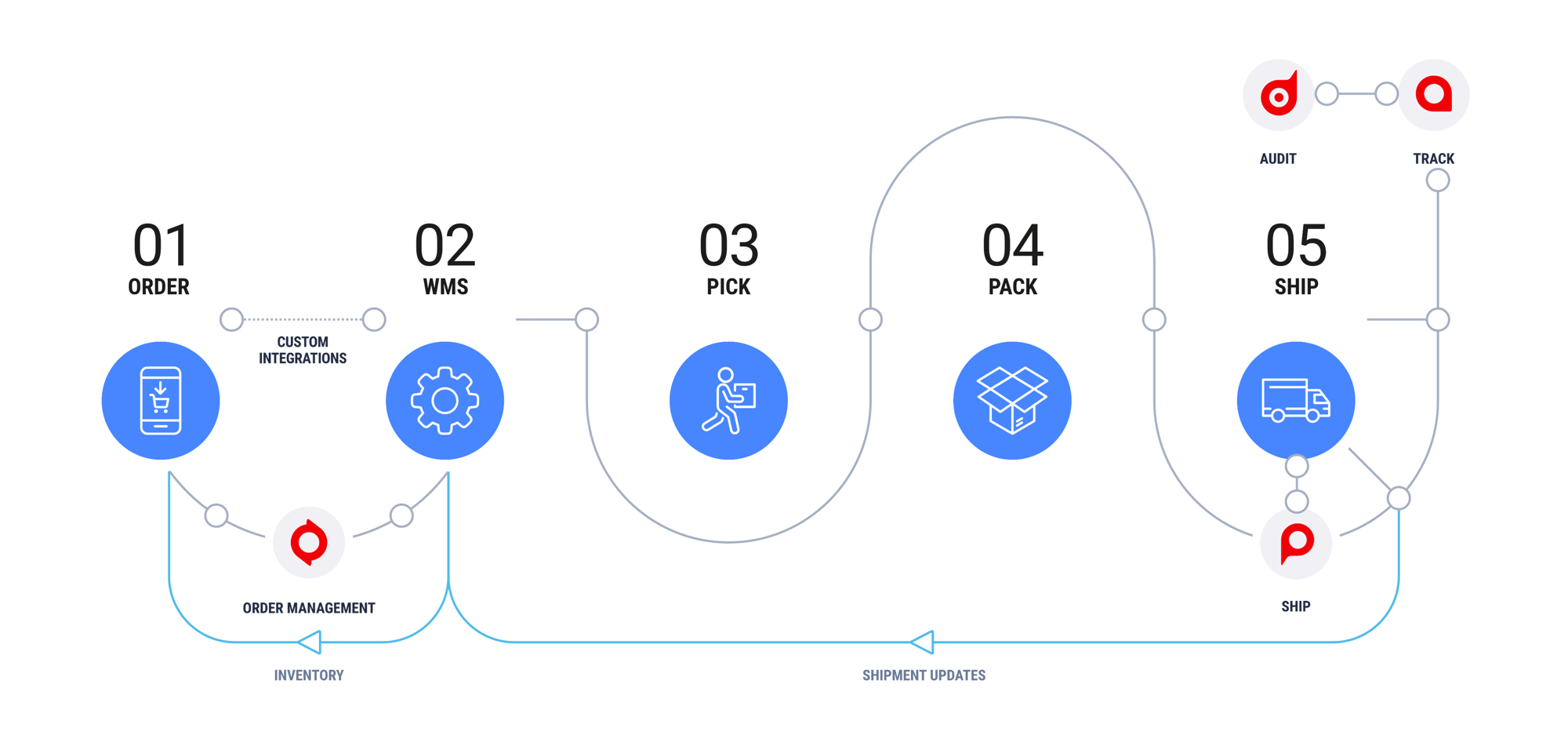
Running beneath those five stages are two continuous data flows:
-
Inventory flows back from WMS to Order, keeping stock levels accurate in real time
-
Shipment updates flow back from Ship to the order layer, triggering tracking notifications and closing the loop for the customer
When these flows break, when systems don't talk, when data is re-entered manually between stages, when inventory counts lag behind reality, the perfect order becomes impossible to achieve consistently.
The sections below walk through each stage: what it involves, where it typically breaks down, and what good looks like.
Stage 1. Order: capture, validation, and routing
Order capture is where the Perfect Order Process begins and where many operations quietly lose control. An order arrives from a sales channel: Shopify, Amazon, Walmart, a direct EDI connection, a branded website. It needs to be validated, enriched with the right data, and routed to the correct fulfillment location before anything physical happens.
Do this stage well and everything downstream moves faster and with fewer errors. Do it poorly and the warehouse is fighting bad data before a single item is picked.
What good looks like
A well-configured order management system (OMS) handles this stage automatically, with no manual data entry and no human decision-making required for standard order flows. Specifically, it should:
-
Connect to any sales channel (whether via API, EDI, CSV, flat file, or XML) without requiring custom development every time a new channel is added
-
Validate incoming order data and flag exceptions before they reach the warehouse
-
Apply routing rules automatically, sending each order to the right fulfillment location based on inventory levels, transit time, cost, or sales channel requirements
-
Handle product substitutions when items are out of stock, using pre-defined rules rather than waiting for manual intervention
-
Split or hold orders based on business logic, for example, holding high-value orders for fraud review, or splitting orders when items are in different warehouses
-
Map data fields from the sales channel format to the WMS format, without requiring IT involvement
Where it typically breaks down
The most common failure here is the gap between the sales channel and the warehouse. Many operations still rely on manual order entry or brittle integrations that break when a channel updates its API. The result: delayed orders, data entry errors, and warehouse teams receiving incomplete or inaccurate order information.
The second most common failure is the absence of routing logic. Without dynamic routing rules, orders default to fixed fulfillment locations regardless of whether that's the fastest or cheapest option. Over thousands of orders, that gap compounds into significant unnecessary cost.
How techOMS handles Stage 1
techOMS by Techdinamics is purpose-built as the bridge between sales channels and warehouse management systems. It connects to any channel (including Shopify, Amazon, Walmart, WooCommerce, NetSuite, Salesforce, QuickBooks, Best Buy Marketplace, BigCommerce, Hudson Bay Marketplace, and more) and applies powerful routing rules automatically so that orders flow without manual intervention.
Its reference mapping capability lets operations teams define how data fields translate from the sales channel to the WMS in plain language, without writing code. And its rules engine handles unlimited combinations of conditions, order value, SKU, channel, transit time, carrier, customer tier, and more, so that every exception is handled by a pre-defined rule, not a human judgment call.
Clients using techOMS report up to 50% faster order processing and up to 90% reduction in order errors.
RELATED RESOURCE
What Is Order Orchestration and Why Does It Matter for Enterprise Fulfillment?

Stage 2. WMS: feeding the warehouse with clean data
The warehouse management system (WMS) is the operational core of any fulfillment operation. It manages inventory locations, directs picking, controls receiving, and maintains the stock data that the rest of the operation depends on. But the WMS can only perform as well as the data it receives.
This is where Stage 1 and Stage 2 connect in ways that most operations underestimate. When an OMS feeds the WMS with clean, validated, pre-enriched order data, complete with carrier account numbers, service level selections, shipping preferences, and routing decisions already made, the WMS can optimize the warehouse floor rather than compensating for upstream gaps.
What good looks like
A well-integrated OMS-to-WMS handoff means:
-
Picking waves are prioritized automatically based on ship method, cutoff times, and service level, so express orders always move first
-
Carrier account information and shipping preferences travel with the order, so the WMS and shipping station already know the correct label format, carrier, and rate before the order arrives
-
Inventory counts stay synchronized in real time between the WMS and the OMS, so the order layer never routes an order to a location that can't fulfill it
-
Workflow modifications that once took weeks to implement can be done in days or hours, because the integration layer handles the complexity
This is where the techOMS-to-WMS integration does its most important work. Techdinamics doesn't replace your WMS, it makes it perform better by ensuring every order that arrives at the warehouse is already complete, pre-validated, and enriched with the routing and carrier decisions already made. Your WMS receives clean data and can focus entirely on optimizing the warehouse floor, rather than compensating for gaps in what the order layer sent through.
Where it typically breaks down
The most common failure between OMS and WMS is data fragmentation. When these systems aren't integrated, or are integrated loosely, teams re-enter data manually between stages, introduce errors, and lose the priority information (service level, carrier, cutoff time) that makes the warehouse floor operate efficiently.
The second failure is inventory lag. When inventory counts aren't updated in real time, the OMS routes orders to locations that can't fulfill them, triggering holds, manual interventions, and customer-facing delays.
RELATED RESOURCE
Why Inventory Accuracy Is Revenue Protection for Enterprises

Stage 3. Pick: reducing errors at the floor level
Picking is where order accuracy is won or lost. A picker walks to a location, selects an item, and places it in a container for packing. Do this correctly at scale and the rest of the process flows cleanly. Introduce errors here, wrong SKU, wrong quantity, wrong location, and every downstream stage is contaminated.
What good looks like
A powerful rules engine at the OMS level simplifies picking before the picker ever touches a product. By the time an order reaches the pick stage, the system should already have:
-
Grouped orders into optimized pick waves based on service level and carrier cutoff
-
Routed each order to the most appropriate picking method for the order type
-
Flagged any exceptions, out-of-stock items, substitutions required, holds, so pickers aren't making judgment calls on the floor
-
Ensured that all order data (packaging type, carrier, client-specific requirements) is already attached to the order
The result is that picking becomes a guided, rule-driven activity rather than a decision-heavy one. Fewer decisions at the pick stage means fewer errors.
Where it typically breaks down
Picking errors almost always trace back to one of two root causes: bad upstream data, or insufficient rules logic. When an OMS passes incomplete or incorrectly mapped order data to the WMS, pickers receive instructions that don't match actual inventory. When there's no rules engine handling exceptions automatically, pickers improvise, and improvisation introduces variability.
RELATED RESOURCE
Exception Management as the Missing Piece of Customer Experience

Stage 4. Pack: packaging efficiency and cartonization
Packing is the stage most operations underestimate for cost. Every oversized box is a dimensional weight surcharge. Every wrong packaging choice is a potential damage claim. Every manual packing decision that could have been automated is unnecessary labor.
What good looks like
Smart cartonization, the automated selection of the right box for the right order, does more than fit items in a container. It:
-
Auto-selects the appropriate package type based on item dimensions, fragility, transit time, and client-specific packaging rules
-
Calculates dimensional weight in advance, so the selected packaging doesn't trigger unnecessary carrier surcharges
-
Guides the packer with precise packing instructions, reducing decision time at the pack station
-
Applies client-specific packaging rules, different materials, inserts, branding requirements, automatically
For operations with specialized requirements, the packaging rules engine can be configured to match materials, handling instructions, and packaging standards to transit time and conditions automatically. eGourmet Solutions, a cold chain 3PL managing temperature-controlled fulfillment across five U.S. facilities, implemented customized packaging SOPs and weather-based SOPs, achieving a 15% reduction in thawed orders and a 20% reduction in client material costs.
How techSHIP handles Stage 4
techSHIP's cartonization tool goes beyond fitting boxes on a screen. It auto-selects the right packaging, generates precise packing instructions for the picker, and factors in dimensional weight at the point of selection, so the pack station never has to make a judgment call, and carrier surcharges from oversized packaging are eliminated before they happen. Client-specific sorting and label requirements are configured at the client profile level, meaning each client's packaging rules travel with every order automatically.
Where it typically breaks down
The most common failure at the pack stage is the absence of cartonization logic. When packing decisions are left to individual judgment, packaging costs are inconsistent, dimensional weight surcharges accumulate unchecked, and damage rates vary by shift and by team.
The second failure is the disconnect between the packing stage and the shipping stage. If the pack station doesn't know the carrier, service level, and label requirements before the box is sealed, packing must be undone or relabeled, adding time and error risk.
RELATED RESOURCE
What Is Cartonization and How Does It Cut Shipping Costs?

Stage 5. Ship: rate shopping, tracking, and auditing
The ship stage is where the order leaves your control and enters the carrier network. It's also where significant cost is either captured or lost. Rate shopping, label generation, tracking, and freight auditing all happen here, and each one is an area where the right technology creates measurable financial value.
What good looks like
Rate shopping: Every shipment should go through real-time rate comparison across all available carriers and service levels before a label is generated. techSHIP does this across 200+ carriers using 150+ condition codes, selecting not just the cheapest option but the option that meets the service level commitment at the lowest cost. Advanced markup and markdown logic lets 3PLs apply tailored pricing structures per client, carrier, and shipment profile.
Label generation and compliance: techSHIP generates labels within seconds, meeting carrier-specific requirements and including all required documentation automatically. Any delay at the label stage becomes a delay in the carrier pickup window, so speed and accuracy here are non-negotiable.
Tracking: Once a shipment is in the carrier network, real-time visibility matters, both for the operation and for the customer. techSHIP's techTRACK feature consolidates carrier updates into a single centralized view, providing real-time statuses, delivery confirmations, and exception alerts without requiring teams to log into multiple carrier portals.
Freight auditing: Carrier billing errors are more common than most operations realize. techSHIP's techAUDIT feature finds rate discrepancies, surcharges, and billing errors automatically, helping accounting teams identify recurring issues and stop being overbilled, without spending hours or days reconciling freight invoices manually.
Clients using techSHIP report an average 35% cost reduction in shipping, a 15% increase in shipping-related profit margins, and 50–90% savings on shipping insurance.
Where it typically breaks down
The most common failure at the ship stage is manual rate selection. When a team member selects a carrier and service level by habit or default rather than by real-time rate comparison, the operation overpays on every shipment. At scale, this represents significant unnecessary cost.
The second failure is freight invoice reconciliation. Without an automated audit tool, billing errors and recurring overcharges accumulate undetected. Most operations don't discover them until they appear as unexplained cost increases months later.
RELATED RESOURCE
What Is a Delivery Promise in E-commerce in 2026?

The role of integrations and real-time data flow
The five stages of the Perfect Order Process are only as strong as the connections between them. Two data flows run underneath the entire operation:
Inventory flow (WMS → Order layer): techOMS keeps inventory synchronized in real time between the WMS and the order layer, ensuring orders are never routed to a location that can't fulfill them. When inventory updates lag (even by minutes) the result is split shipments, holds, and customer-facing delays.
Shipment updates (Ship → Order layer): When a shipment is confirmed, techSHIP's techTRACK feature sends that information back through the system immediately, updating inventory, triggering tracking notifications, and closing the order loop. Without this, customer service teams are answering "where is my order?" questions without accurate information.
Custom integrations: any-to-any connectivity
Every sales channel, WMS, ERP, and carrier speaks a different data language. EDI, API, CSV, flat file, XML, Excel, PDF, a fulfillment operation that services multiple clients or sells across multiple channels is managing a complex data translation problem on top of an already demanding physical operation.
techOMS handles any-to-any connections, not with one-size-fits-all connectors, but with fully managed integrations scoped to the specific needs of each client and warehouse. The system converts incoming data formats to the operation's internal standards without altering existing workflows. Custom business rules, order splitting, holds, SKU mapping, shipping account assignment, are applied automatically.
Integrations that once required months of custom development can go live in as little as 10 minutes for plug-and-play connections, or 2–6 weeks for fully customized builds. And because integrations are fully managed, the operations team isn't responsible for maintaining them when a sales channel updates its API.
Common failure points, and how to fix them
Most fulfillment operations don't fail at one stage catastrophically. They leak precision across all five stages simultaneously, small errors that compound into significant costs and customer experience problems over time.
These are the most common failure points and their fixes:
Manual data entry between systems. The fix is any-to-any integration with a data transformation engine that handles format translation automatically. Manual entry is eliminated at the source.
Inventory counts that don't match reality. The fix is real-time two-way inventory synchronization between the OMS and WMS, so both systems always reflect actual stock levels.
No routing logic. Without dynamic routing rules, orders go to default locations regardless of cost or transit time. The fix is an OMS rules engine that routes each order based on live data: inventory, carrier rates, transit time, and service level.
Carrier selection by habit. The fix is automated rate shopping across 200+ carriers at the point of shipment processing, with conditions applied in real time.
Freight invoice errors going undetected. The fix is automated freight auditing that catches rate discrepancies, surcharges, and billing errors before they accumulate.
New client onboarding taking weeks. The fix is a reference mapping capability that lets operations teams define data field translations without writing code. Simple connections go live in as little as 10 minutes. Complex, fully customized integrations go live in 2–6 weeks.
RELATED RESOURCE
What End-to-End Shipment Visibility Requires

How to measure your Perfect Order performance
The Perfect Order Rate formula
The Perfect Order Rate is a composite metric. All four conditions must be met for an order to count as perfect:
Perfect Order Rate = (% on-time) × (% complete) × (% damage-free) × (% correctly documented)
This is an industry-standard formula, and the multiplier effect is what makes it both powerful and humbling. APQC illustrates it with this example: an operation running at 98% on-time, 97% complete, 99% damage-free, and 82% correct documentation has a Perfect Order Rate of just 77.16%:
0.98 × 0.97 × 0.99 × 0.82 = 77.16%
Four metrics that each look acceptable in isolation combine into a result where nearly one in four orders has a problem. That is APQC's data, and it explains why organizations that rely on siloed metrics like on-time shipment rates alone consistently overestimate how well their operation is performing.
The KPIs that matter at each stage
These are the operational metrics supply chain practitioners track at each stage to diagnose where Perfect Order performance is being lost:
Stage 1. Order:
-
Order processing time (from receipt to WMS handoff)
-
Exception rate (orders requiring manual intervention)
-
Routing accuracy (orders sent to optimal location vs. default)
Stage 2. WMS:
-
Inventory accuracy rate
-
Order-to-pick lead time
-
Inventory sync latency (how quickly stock updates propagate)
Stage 3. Pick:
-
Pick accuracy rate
-
Orders picked per hour
-
Exception rate at the pick stage
Stage 4. Pack:
-
Packaging cost per shipment
-
Dimensional weight surcharge rate
-
Pack station cycle time
Stage 5. Ship:
-
On-time ship rate
-
Carrier cost per shipment vs. rate-shopped optimum
-
Freight invoice error rate
-
Shipment tracking update latency
Benchmarks worth knowing
According to APQC data, perfect order performance sits at 88% at the median, meaning 12% of all orders being shipped have some form of failure. Top performers (75th percentile) reach 93%. Bottom performers (25th percentile) sit at 82%. Closing that gap requires consistent improvement across all four-component metrics simultaneously, not just one, because the multiplier effect means gains in a single metric produce smaller composite improvements than most operations expect.
What does reaching the top look like in practice?
eGourmet Solutions, a cold chain 3PL managing temperature-controlled fulfillment across five U.S. facilities, achieved a 99.98% on-time, in-full fulfillment rate and 99.99% inventory accuracy after implementing techOMS, while handling a 450% increase in fulfillment volume from 2020 to 2024. Orders shipped per hour increased by 37%. Orders picked per hour increased by 49%.
Ready to build your Perfect Order Process?
The Perfect Order Process isn't a destination; it's an operational standard that compounds over time. Every stage you tighten reduces cost, reduces errors, and strengthens the client relationships that your business depends on.
Techdinamics helps 3PLs, brands, and retailers build the technology foundation to achieve it: from order capture to final-mile shipping, from custom integrations to freight auditing. It is how we make businesses get orders out the door faster, with fewer errors, and lower operating costs.
FAQs
What is a Perfect Order in fulfillment?
What is the Perfect Order Rate and how is it calculated?
What is the difference between an OMS and a WMS?
What causes the most fulfillment errors?
How long does it take to integrate a new sales channel or client?
What is cartonization and why does it matter for shipping costs?
What is freight auditing and how much can it save?
How does real-time inventory synchronization affect the Perfect Order Rate?
Notes
Product ROI statistics based on average client-reported results and AI-supported internal research. Individual results vary.
eGourmet's case study was published on SupplyChainBrain in July 2026 - "How eGourmet Solutions Scaled Up Cold Chain Fulfillment Through a Partnership With Techdinamics"
Perfect Order Rate benchmark data sourced from APQC (American Productivity and Quality Center) - "Perfect Order Performance: Achieving the Impossible Dream”.
Ready to fulfill smarter?
Let’s work together to uncover the fulfillment strategy that best fits your operations and maximizes your ROI.