Cartonization is the automated process of selecting the most efficient shipping box for each order based on item dimensions, weight, and volume utilization requirements. For 3PLs, fulfillment centers, and e-commerce brands, it is one of the most direct levers available for reducing shipping costs without changing carriers or renegotiating rates.
On average, cartonization reduces total shipping expenses by 10 to 20 percent, equating to $192,000 per year for mid-size shippers processing 10,000 orders per month, and up to $1.92 million per year for high-volume operations. This article explains how cartonization works, where the savings come from, and how techSHIP automates the entire process.
POV Insights: Maximizing Value with 10,000 Monthly Shipments
-
Reduction in Dimensional Weight (DIM) Fees: Average annual savings of $120,000
-
Lower Shipping Costs Through Reduced Box Counts: Average annual savings of $144,000
-
Savings on Packaging Materials: Average annual savings of $60,000
-
Minimized Damage Claims: Average annual savings of $60,000
What is Cartonization?
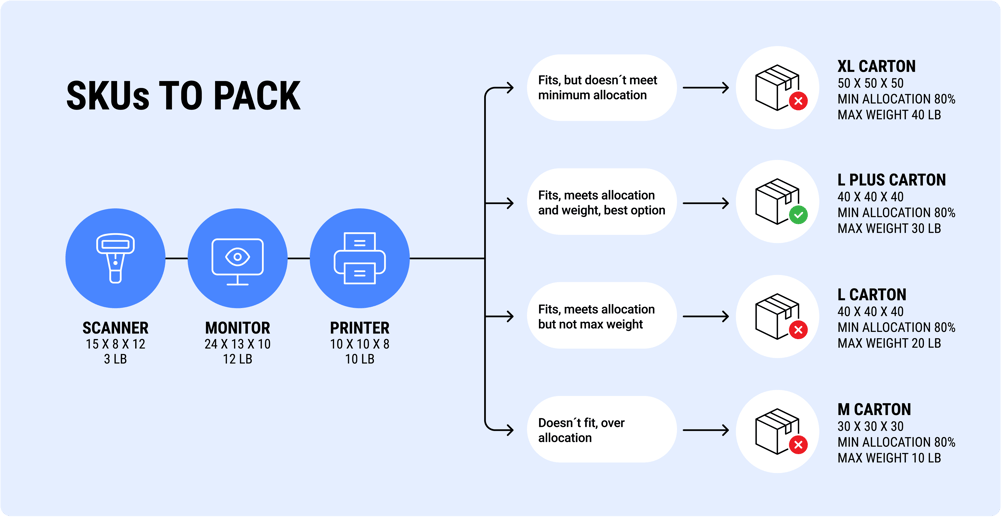
Cartonization is the process of optimizing how items are packed by evaluating the best fit for shipping boxes based on several factors:
- Dimensions: Ensures items fit within the internal dimensions of the selected box.
- Maximum Weight: Confirms the total weight of items doesn’t exceed the box’s capacity.
- Minimum Volume Utilization: Avoids using oversized boxes by ensuring a specified percentage of the box’s internal space is filled.
What Is Smart Packaging? SIOC, SIPP, and Cartonization Working Together
In addition to cartonization, Smart Packaging enhances your shipping operations by addressing the unique challenges of SKUs requiring separate handling, including items that qualify for SIOC (Ships in Own Container) or SIPP (Ships in Product Packaging). While cartonization optimizes box selection for most items, Smart Packaging ensures specialized items are handled with precision and care.
Benefits of Combining Smart Packaging, SIOC/SIPP, and Cartonization
- Precision Handling: Automates the separation and repacking of specialized SKUs, ensuring items shipped under SIOC or SIPP are handled efficiently and shipped in their original packaging.
- Optimized Efficiency: Reduces shipping costs by ensuring all items—whether individually packed, cartonized, or shipped in their original container—are packed to maximize space and minimize costs.
- Improved Sustainability: Reduces waste by leveraging original packaging for SIOC/SIPP items and optimizing box selection for others.
- Seamless Integration: With a simple checkbox, enable Smart Packaging on an SKU-by-SKU basis, tailoring the shipping process to meet specific customer needs.
The ROI of Cartonization: Cost Savings, Sustainability, and Customer Satisfaction
Efficient cartonization delivers measurable benefits:
-
Cost Savings: By minimizing void space and reducing the number of boxes used, businesses can lower shipping expenses by 10–20%.
-
Sustainability: Using fewer materials and optimizing space improves your environmental impact, resonating with eco-conscious customers.
-
Customer Satisfaction: Properly packed orders are less likely to be damaged during transit, ensuring a better delivery experience.
1. Reduction in Dimensional Weight (DIM) Fees
Shipping carriers charge based on dimensional weight when a package's size exceeds a certain threshold, even if it’s lightweight. By minimizing void space, cartonization helps ensure smaller package dimensions, reducing these fees.
Example:
A package with 30% void space may incur DIM fees of $10. Optimizing the package to a smaller box could eliminate those fees entirely.
For 1,000 shipments per month, this could save $10,000/month or $120,000/year.
2. Lower Shipping Costs from Reduced Box Counts
By consolidating items into fewer, well-optimized boxes, businesses can reduce the total number of shipments.
Example:
Shipping 10,000 orders/month at $8 per package = $80,000.
If cartonization reduces box usage by 15%, monthly costs drop to $68,000—a savings of $12,000/month or $144,000/year.
3. Savings on Packaging Materials
Efficient box selection reduces the use of oversized cartons and unnecessary fillers like bubble wrap, packing paper, or foam.
Example:
Reducing filler usage by 20% for 10,000 shipments could save $0.50 per package = $5,000/month or $60,000/year.
4. Fewer Damage Claims
Properly packed items are less likely to be damaged in transit, reducing the costs associated with refunds, replacements, and expedited reshipping.
Example:
If damage claims account for 2% of 10,000 monthly shipments at an average cost of $50/claim, this equates to $10,000/month in claims. Reducing damages by 50% saves $5,000/month or $60,000/year.
Total Potential Savings
By combining savings from DIM fees, shipping costs, packaging materials, and reduced damage claims, businesses using cartonization typically see total cost reductions of 10–20% in shipping expenses.
For a mid-size shipper
- Shipping 10,000 orders/month at $8/order = $80,000 baseline.
- Savings at 10–20% = $8,000–$16,000/month or $96,000–$192,000/year.
For a high-volume shipper
-
Shipping 100,000 orders/month at $8/order = $800,000 baseline.
-
Savings at 10–20% = $80,000–$160,000/month or $960,000–$1,920,000/year.
Conclusion
The savings from cartonization are substantial, particularly for businesses with high shipping volumes. By optimizing box usage, reducing DIM fees, and minimizing material waste, cartonization can deliver a robust return on investment while improving operational efficiency and customer satisfaction.
How techSHIP Automates Cartonization: Predefined Boxes, SKU Data, and Intelligent Box Selection
techSHIP takes cartonization to the next level by automating box selection during the import process.
Here’s how it works:
Predefined Boxes
Define your available box types, specifying dimensions, weight limits, and minimum utilization parameters. techSHIP supports client-specific configurations, allowing flexibility for varying needs.
SKU-Level Item Details
Input the dimensions and weight of each SKU in your inventory. This critical information helps techSHIP accurately calculate the best fit for each item or group of items.
Automated Box Selection
During the import process, techSHIP automatically evaluates all predefined box options. It chooses the box that:
- Accommodates the items’ dimensions and weight.
- Meets the minimum volume utilization requirement.
- Maximizes efficiency and minimizes excess packaging.
Example:
Imagine you have four predefined box sizes—Small, Medium, Large, and Extra Large. techSHIP evaluates your shipment and selects the smallest box that satisfies all the criteria. A box too small won’t fit the items, while a box too large could fail the volume utilization check. This precision ensures the most efficient choice every time.
How Smart Packaging Works with techSHIP's Cartonization
When specific SKUs need separate handling, techSHIP's Smart Packaging automatically removes these items from the WMS's original packaging setup and treats them as individual packages. If cartonization is applied, these items are repacked into boxes matching their specific dimensions, ensuring efficient packing. Meanwhile, items qualifying for SIOC or SIPP are shipped in their original packaging, bypassing unnecessary repacking steps, while the remaining SKUs are cartonized as usual.
Example in Action:
Imagine a SKU qualifying for SIOC due to its sturdy product packaging. Smart Packaging identifies this during the import process and ships it in its original packaging without additional repacking. Simultaneously, other SKUs are cartonized for optimal space utilization and cost savings. For fragile or custom items that don't qualify for SIOC or SIPP, Smart Packaging repacks them in boxes tailored to their dimensions.
By integrating Smart Packaging with cartonization, and incorporating SIOC or SIPP protocols, techSHIP delivers a comprehensive solution. This approach empowers fulfillment centers to meet customer demands, optimize shipping costs, reduce waste, and maintain operational excellence.
━━━━━━━━
Frequently Asked Questions
What is cartonization in shipping and fulfillment?
Cartonization is the automated process of selecting the optimal shipping box for each order based on item dimensions, weight, and minimum volume utilization requirements. It helps 3PLs, fulfillment centers, and e-commerce brands reduce dimensional weight fees, lower packaging costs, and minimize damage claims.
How much can cartonization reduce shipping costs?
On average, cartonization reduces total shipping expenses by 10 to 20 percent. For a mid-size shipper processing 10,000 orders per month at $8 per order, that translates to savings of $96,000 to $192,000 per year. For high-volume operations at 100,000 monthly shipments, savings can reach $960,000 to $1.92 million annually.
What is the difference between SIOC and SIPP in shipping?
SIOC (Ships in Own Container) refers to items whose original product packaging is sturdy enough to ship without additional boxing. SIPP (Ships in Product Packaging) follows a similar principle, where the product ships in its own packaging. Both approaches reduce waste and repacking labor, and both are supported by techSHIP's Smart Packaging feature.
━━━━━━━━
Why Cartonization Is a Must-Have for 3PLs and Fulfillment Operations
Cartonization is one of the most practical cost-reduction tools available to 3PLs and fulfillment operations, directly reducing DIM fees, packaging waste, and damage claims without requiring carrier changes or rate renegotiations. With techSHIP’s cartonization capabilities, you can reduce costs, improve sustainability, and enhance customer satisfaction, all while streamlining your packing process.
For a detailed walkthrough on setting up cartonization in techSHIP, check out our [Step-by-Step Guide].
Want to see how techSHIP's cartonization works in practice? Schedule a call with our team today!