If 2024 was the year of experimentation, 2025 was the year everything finally started to connect.
Across the fulfillment industry, operations that once relied on disconnected tools and manual work began to align around three priorities: visibility, predictability, and performance.
Our first Techdinamics Customer Insight Survey reflected this shift. The majority of respondents were 3PLs and fulfillment operators across North America, and a clear trend emerged:
- Only 17% still operate mostly manually
- 55% describe their fulfillment as partially automated
- 29% now consider themselves fully integrated end-to-end
This mix shows an industry in transition, where modern tools are gaining momentum, but legacy processes still exist.
We also saw foundational automation gaining traction:
- Over 60% have adopted digital scales & weight capture
- Nearly 40% use automated dimensioning/cubing
And 40% of respondents invested in new fulfillment technology in 2025, especially WMS upgrades, carrier optimization, and integration platforms.
The story is not that everyone is fully modernized. The story is that 2025 marked the year fulfillment finally started moving in the same direction.
“2025 didn’t change what we do, but it changed how we think about doing it,” John O’Neill, President, J. P. Enterprises.
The pressure that volume swings put on fulfillment networks will only continue to grow.
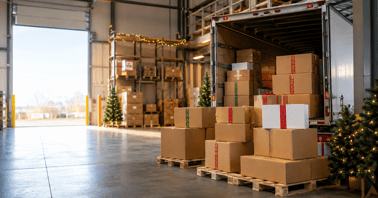
During the 2025 Black Friday–Cyber Monday period, more than 1.5 million packages moved through techSHIP—a 27% year-over-year increase—with UPS, FedEx, and UniUni standing out as the most-used carriers across our network.
These results mirror what we saw across the broader market and highlight a trend that goes beyond peak season volume, pointing to operators’ growing need and ability to handle demand with greater visibility, predictability, and performance.
The Data & Intelligence Revolution
Black Friday and Cyber Monday 2025 once again pushed e-commerce to new highs. Black Friday online spending reached US $11.8 billion—a ~9% year-over-year increase—while Cyber Monday tracked toward a projected US $14.2 billion, marking another record-setting peak.
If one force defined 2025, it was data. Not in theory, but in practice.
Our survey revealed that:
- 40% use analytics across all operations
- 57% use analytics in most or some areas
- Only 26% rely solely on basic reporting
Where analytics is used, leaders focus on the metrics that matter most:
- Fulfillment speed
- Cost per order & carrier spend
- Delivery performance
- Inventory accuracy
These are not vanity metrics. They are the levers that drive profitability. And the organizations that invested in new systems this year saw results quickly:
- 53% saw measurable impact within 3 months, primarily in the form of faster processing, fewer errors, and better labor utilization.
But gaps remain. Exception handling is still the single most manual process for many operators—a signal that BFCM 2025 likely pushed some systems to their limit.
What’s clear is that 2025 marked a turning point: visibility began shifting into foresight.
Insights from Analyst, Influencers & the Floor
2025 was also the year the narrative around fulfillment became more honest—and more aligned.
Across industry events, analyst briefings, and LinkedIn commentary, one idea kept emerging: technology doesn’t replace people. It enables them.
Operators we spoke to said the changes they made in 2025 didn’t eliminate work but actually improved it.
Automation reduced repetitive strain. Integrations reduced error-prone tasks. Data reduced firefighting.
As Kristen Gameiro, Director of International Operations at J. P. Enterprises, puts it:
”Automation gave us time to do our jobs better.”
Influencers and thought-leaders shifted their focus as well. What used to be conversations about packaging and unboxing moved toward discussions about sustainability, operational resilience, real-time visibility, and tech-enabled scaling.
This shift mirrored a broader truth: fulfillment became a strategic differentiator, not a cost center.
What Our customers Taught Us
Our inaugural survey revealed the clearest industry picture we’ve seen in years. One that confirms both momentum and opportunity.
The Highlights That Matter Most
1. Integration is no longer optional.
Nearly 70% have integrated WMS, ERP, carrier APIs, or OMS systems. And it remains the highest-ROI initiative of the year.
2. Automation investment is accelerating.
40% added new fulfillment tech in 2025, with WMS, shipping optimization, and integration middleware leading the way.
3. Budgets are the biggest barrier.
64% cite budget constraints as the main challenge to modernization—more than IT resourcing or integration complexity.
4. The biggest pain points remain unchanged.
Rising carrier rates, exception management, and siloed or outdated systems.
5. The top priorities for 2026 are clear.
48% plan to upgrade technology.
38% aim to hire or expand teams.
31% plan to grow fulfillment capacity.
52% plan to add new carriers.
29% expect to implement AI-driven exception management.
The message is unmistakable: operators are modernizing in stages, but almost everyone is moving.
The Road to 2026
Looking back, 2025 was the year fulfillment found its direction.
Not every operation is fully automated or deeply integrated. However, the shift toward connected fulfillment is undeniable.
This year’s survey revealed that teams want to work smarter, not harder. They want fewer silos, fewer exceptions, and more reliable data. They want technology that helps people perform at their best.
As we enter 2026, the challenge will be unlocking more value from the tools already in place rather than just adding new ones.
Fulfillment’s future is intelligent, integrated, and human-centered: automation handles the tasks, while people handle the decisions that define the customer experience. And at Techdinamics, we’re excited to help lead that future.