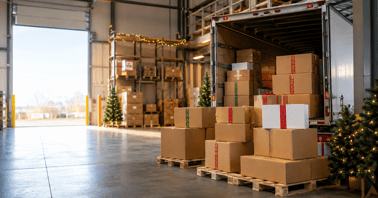
Black Friday and Cyber Monday (BFCM) may be the most publicized retail surges of the year, but they are no longer the only moments that test fulfillment networks. Today’s ecommerce world is defined by unpredictable volume swings—sometimes planned, often not. Flash sales, seasonal promotions, influencer moments, major announcements, and new customer launches can generate BFCM-level pressure any day of the year.
Across our 3PL network, we see this reality daily. Several fulfillment partners support brands whose volumes can jump from 30,000 to more than 100,000 packages in a single day when a product goes viral. What once felt like a rare event is now part of the rhythm of modern commerce.
That’s why BFCM is no longer just a holiday milestone. It’s the clearest operating model for managing every high-volume surge.
2025: The New Benchmarks for Scale
Black Friday and Cyber Monday 2025 once again pushed e-commerce to new highs. Black Friday online spending reached US $11.8 billion—a ~9% year-over-year increase—while Cyber Monday tracked toward a projected US $14.2 billion, marking another record-setting peak.[1]
Across the broader Thanksgiving-to-Cyber-Monday period, online demand contributed to an anticipated US $253.4 billion holiday season, reinforcing how deeply consumers rely on digital retail.[2]
These numbers tell us one thing clearly: peak keeps growing—both in revenue and operational demand.
The Reality Behind Peak Volume
Behind every dollar in BFCM revenue is a package that must be picked, packed, and delivered—and the growth in parcel volume shows no signs of slowing.
Inside the techSHIP ecosystem, the 2025 results were even more pronounced. On BFCM alone, techSHIP processed 1.5 million shipments, a 27% increase from last year, with UPS, FedEx, and UniUni leading the way.
Across our 3PL network, volume volatility is constant. Some brands surge 50–200% above normal during flash sales or “gift-with-purchase” campaigns. Others routinely jump from 30,000 to more than 100,000 packages in a single day when a product goes viral.
In one recent case, a top influencer spotlighted a customer’s product and shipments exploded overnight—instantly replicating Black Friday conditions. Couriers tightened, transit stretched, and packing lines expanded to keep up.
These spikes may not come with BFCM’s publicity, but operationally, they behave exactly the same. This is the new reality: BFCM-level volume, any day of the year.
The New Operational Normal
The stresses we witness every November—surging parcel counts, courier bottlenecks, extended transit timelines, rising DIM and handling fees—now surface throughout the year. Regardless of what triggers the surge, the operational symptoms are identical:
- Shipments outpace labor and space capacity
- Courier networks tighten
- Transit times extend
- Surcharges stack quietly
- Packaging and staging zones reach maximum load
- Customer expectations remain unchanged
Whether the spike comes from Black Friday deals or a viral TikTok, the pressure on fulfillment operations is the same.
Peak Season Principles That Apply All Year
Cartonization: Control Costs at Scale
Smart cartonization not only selects the right box—it automates packaging selection, prevents over-packing, and applies exact DIM charges every time. During sudden spikes, this precision protects margins and accelerates throughput.
Advanced Rate Shopping: Navigate Network Stress
Dynamic rate shopping evaluates 100+ condition codes—transit time, zone, weight, service level, surcharge exposure—to determine the best carrier in real time. With the ability to add or remove couriers instantly, teams stay agile even during major surges.
Insights & Analytics: Replace Guesswork with Clarity
Real-time insights give teams the foresight they need. Monitoring courier performance, transit delays, cost per shipment, surcharge trends, and exception spikes enables fast, data-driven decisions when pressure rises.
Courier Diversification: Build a Resilient Network
Relying on a single carrier is a single point of failure. A diversified mix—national carriers, regional specialists, hybrid postal options, and cross-border partners—keeps parcels moving even when networks tighten.
Automation: Consistency at Scale
Automation ensures routing, packaging, and carrier-selection decisions are fast, accurate, and repeatable. With pre-built rules and workflows embedded directly into systems, operations scale smoothly under pressure.
Final Summary
Black Friday and Cyber Monday 2025 reaffirmed their role as the defining ecommerce moments of the year—driving tens of billions in revenue and pushing parcel volumes to new extremes. But the larger story extends far beyond the holidays.
Influencer spikes, flash sales, restocks, and new-customer launches now create surge events that rival—and often exceed—traditional BFCM peaks. The fulfillment centers that succeed aren’t the ones preparing once a year, but the ones operating peak-ready every day.
With smart cartonization, dynamic rate shopping, real-time insights, courier diversification, and automation, logistics teams aren’t just absorbing volatility—they’re transforming it into competitive advantage.
In modern ecommerce, peak isn’t a season. It’s an operating model.
[1] Adobe – "Cyber Monday Hits Record $14.25 Billion in Online Spending with Over $1 Billion Driven by Buy Now Pay Later”
[2] Adobe – “U.S. Holiday Shopping Season to Cross $250 Billion Online, Rising 5.3% YoY”